Jake Pavlica
Composing the Self
Memoir
Final Draft
The Wall of Plaid
Finding music was like love at first sight. Better yet, finding music was love at first
sound. Like meeting eyes with a beautiful stranger in a crowded place, I became intoxicated with
playing music. Before any tangible memories took hold in my mind I can remember being in a
dank, hazy bar. My father was on stage, blocked by the swaying hips of the lead singer. I was sat
at a nearby table next to my mother, watching the purple stage lights flash across my dad’s golden cymbals. “The wall of plaid” he used to call it; in reference to the fact that his whole career as a musician had been spent behind people, holding down the groove and keeping the tempo. As a child I felt that this was some normality. I didn’t know anything other than it. I would go to these clubs to watch my dad. I would see the audience dance and sway like blades of grass as the different songs would take hold of them. Beyond of the flash of the guitarist, the sultry bellow of the bass, and the charismatic timbre of the singer was my father. He was the engine of the vehicle. His role in the band was to set the mood. When he played loud, the other band members met his ferocity. When he played slow, the band played slow.
When I was about eight or nine I decided to give music a shot. I had never been attracted the organized sports, though I had done them all. I never like being put on a team that I didn’t pick myself. I didn’t have the fire for it that other kids did, so I turned to the only thing that stood out to me in my short life. I started off with guitar; appealing to some egotistical sense of wanting to be the big, impressive rock star. I found out that I had no patience to learn scales or learn the intricate finger movement that are an obvious necessity. Frustrated, I turned to the piano, hoping to be able to grasp some of the melodic elements I had hoped to find in guitar. I was met with the same frustration. It then occurred to me that I didn’t need to spend money on lessons, or this other equipment that I didn’t need. I turned to the drums, and I fell in love. The childlike, primal release of hitting something really appealed to me. I liked the noise. It was the first thing I listened to when a song came on the radio, because it was the only thing I would watch at my dads shows. My dad offered to show me some of the ropes. He taught me how to keep time and how to subdivide my body into different, independently operating parts. I grasped the basics and set my eyes on the greater picture. What is a drummer without a band? Basically just atonal noise. An arrangement was made where a few of my friends, who had
the same fondness for music, and myself would get together with one of my friend’s dads to learn songs. Through this I learned how to work in a unit and how to feed of the playing of others. When a song called for a solo, I would lay back in “the pocket” and give the spotlight to the soloist. The glory of drums is to be the mortar that holds the bricks together. When we had all
gotten comfortable enough and felt that the experiment had run its course, the group cordially operated so that we could pursue our respective passions.
I set out to form a group of my own. I wanted to find the camaraderie that I saw in other bands as well as the creative environment in which I could express myself and write songs of my own. In a guitar class I was fortunate enough to find just that. The five of us were cut from the same cloth. Different patterns, all of us, but with enough common group and diversity to embark on something special. We rehearsed tirelessly, trying to find out what we really sounded like. We played covers in hopes that we would achieve the level of virtuosity that our idols had. We argued about our direction and the influences we would incorporate. My upbringing swayed me toward classic-rock, like Led Zeppelin and Black Sabbath, while some of my other band mates skewed more to modern music. We started a trial by fire; to just sit down and write an original in hoped to unveil it at an upcoming concert for our school music program. We worked tirelessly on it, directing every piece and practicing it over and over until we could hardly stand the sound of it. When the concert rolled around we were reluctant to even play it. We ascend dot the stage and went through the usual set list of cover songs we had leaned, all the while dreading what we would do when it came time to bust out the original. We ended our last cover song and stared into the crowd. My drum sticks were slick with nervous sweat as the five of us locked eyes and I counted us into the original. In that moment something clicked. Everyone hit their parts and not a note or beat was out of place. My final cymbal crash hit and the audience erupted into applause. In retrospect I know that the song was really no good, but the feeling of letting people hear a apiece of yourself was so gratifying that I knew we had tapped into something.
For the next four years we were a machine. We rehearsed once a week at a local studio
for two and a half hours. We ran through old songs, wrote new ones, returned to old ideas in
hopes to forge them into something worthy of live performance. We had fire in our bellies
waiting to be expelled. I myself had expanded my scope of music to outside classic rock. I began
listening to fusion, jazz, R&B, soul, and funk all in hopes to discover some new tool to put in my
arsenal.
The concerts that followed this period of intense practice were some of the most exhilarating times of my life. We began frequenting local festivals; one of our best being a carnival in Culver City. The entire park and baseball diamond was transformed into a fair ground, like something out of a movie. On the far side of the twinkling lights and the delightful screams was a stage. In the green room all of us quaked with anticipation and nerves. I furiously practiced my rudiments on a dilapidated folding chair. My bandmates paced around the tent and when we heard the band before us hit their final note we all snapped into shape. Like a hive of trained ants we set up our instruments. As I screwed my cymbals into place I glanced out over the crowd. Teenagers slowly moved forward toward the stage, seeing that we were like them.
When I sat down behind my drum kit, the dance floor was packed with familiar and unfamiliar faces. This was the first gig that wasn’t just a bunch of sympathetic family friends coming to support and take photos. These were real people that we were drawing to us. I counted us into the first song and the crowd began to move. We had never had a mosh pit, or dancing at a show before. It was usually bystanders standing in front of us for a moment before moving on. The crowd in from of us was engaged and present. Like vampires we fed off of their energy and a stage presence we had never known began to emerge. I would lock eyes with my bassist and he
would jump over, his head inches from my cymbals and we would lock into the rhythm of the
song.
After the set, the five of us descended upon the carnival in a manic euphoria. It was a new sensation all together. New faces approached us to compliment us and the feeling was indescribable. We went on all the rides and hollered like monkeys at the top of the farms wheel over the carnival which we felt like we ruled.
From that point on there was no going back for me. Never again would I play to a show full of parents or unenthusiastic onlookers. I knew there had to be something else out there, something like the crowd I had seen at the carnival. In the weeks following a friend of mine approached me with a proposition that would change my life. She was in a band like me, but the two groups had never crossed paths for a show. I had seen them at their first show ever and instantly saw potential in their material. The sound was rough yet coated in a smooth sultriness that drew me in like a sirens song. In the crowd of their show I found myself drumming on my thighs along with their songs. My friend, who was the bassist approached me at school. She told me that their drummer was not going to be able to play a few of the show they had booked for the early weeks of summer and she asked me if I would fill in. I was skeptical at first. I thought about my bandmates. I thought they would see me playing with another band as a betrayal and I wasn’t willing to take that chance. I told my friend that I would let her know at the end of the day and she said that was perfectly fine. I raced over to my band mates, who were sitting in a circle on the concrete yard of our school, and I told them about the proposition.
“You’re still going to be in this band though, right?” the lead singer asked.
“Of course, of course.” I assured them. “This is just a one-time thing.”
I was wrong. This was not a one-time thing. The gig I played with my friend’s band was at the Whiskey A Go-Go on the Sunset Strip. The venue is best known for being the playground of some of musicals biggest artists in the seventies and eighties and I was not about to tarnish that reputation. I rehearsed with this new band for weeks in preparation. What I did not expect was that I would form such strong bond with all of them. In the garage, adorned with Christmas lights, I found that not only did I have musical brothers in my other band, but I had sisters that I just discovered. The lead singer of the new band and I shared a mutual love of Black Sabbath and Led Zeppelin that would become the bedrock of an indestructible friendship. Even my friend, who brought me into the fold, and I found a new side to our relationship by playing together as a rhythm section. On the night of the show at the Whiskey I was nervous as all get out. The dimly lit booths in the back of the venue seemed like something out of a Mobster movie, and all I could do was imagine all of my idols sitting down on the red leather, looking at me with looks that say “well,whatcha got, kid?”
Like I had done so many times before I set up my drum kit. The purple and orange flood lights that seemed to be suspended on nothing beat down on my face and shoulders. The sound guy who shouted from his perch on the balcony told me to sound check the drums. Every piece of percussion was tuned to perfection and a sound like a thunderstorm trapped in a train tunnel blasted forth into the club.
The chemistry on stage that ensued was unlike anything I had seen. The girl’s hair bounced and flowed to the rhythms I set out and the sound could be described as mammoth.
Unlike the carnival, where I could see every face in the crowd, I was left completely in the dark.
The flood lights blinded me from everything other than what was on stage in front of me. It felt like we were suspended in space, playing to no one, but we didn’t care. Song after song we were in unison and we all knew this would not be a one-time thing. Just as quick as it began it was over. The house lights came on to reveal a packed dance floor, boisterous applause and cheers as well as numerous alcoholic beverages suspended in the air in salute of us.
From this point on I was a part of the band. I was now rehearsing twice a week. Once, on
Wednesdays with my new band for 3 hours in the garage, and once with my old band for two hours in our studio space. It felt right, being utilized as a player and also being able to divide my creativity into two different mediums. I enjoyed the different processes each band would engage in and in every practice I would try to find the root my unique style of playing.
For a few months the two bands were able to coexist in harmony, even coming together to play shows together. This meant me having to stay on stage a play two sets but the constant flow of adrenaline prevented me from feeling any of the exhaustion of that. Finally, it came time for everyone to go off to school. The dreams of touring taught with my first band, a band I had helped create, was gone. I knew it was the end, even though we all talk about getting back together over breaks to play shows. I knew it had come to a close and I think they all did too. We had grown together so much. The people and players we were four years ago when we started were unrecognizable to us in the best way. Slowly everyone filtered out of view to head down their own path, yet I felt like I was staying behind to keep going. The new band was gaining
moment in the local music scene and I was fortunate enough to have that rebound averrable to me. I still had access the that medium to release stress and stay creative.
The new band took the place of the family I had felt like I had lost. The new sisters I had found also introduced me to a grander musical family that spanned further than I could have imagined. I was like Alice falling into the rabbit hole. On the other side of the one dimensional world of live performance I thought I knew was a colorful world of art and camaraderie I thought only existed in movies. I began playing house shows held together by Christmas lights and the promise to allow anyone of all ages and background inside. It was a place of inclusivity and diversity that made this family tree of mine grow tenfold. I can’t paint a vivid picture of any one in particular, they all hold the same charm, just in a different location each time. Backyards
became the breeding ground for networking and dancing alike; people from all over the city converging on this one location to share and enjoy music and art. I remember being so relieved that I was moving away from legitimate venues packed with family friends. Here were kids just like me who had no clue who they were until they entered the gates of a show.
Category: Uncategorized
Research Sources
- Do opposites really attract
- https://www.telegraph.co.uk/news/science/science-news/12170295/Relationships-opposites-do-not-attract-scientists-prove.html
- I want to use more relatable social sources, such as articles if I were to chose this topic
- For all of my proposed ideas I want to base my finding on research that I have done, rather than just checking the work of others to prove THEIR hypotheses. I want find my own standing on the issue
- What defines people? (Culture vs. Genetics)
- https://www.psychologytoday.com/us/blog/women-who-stray/201506/can-we-choose-our-identity
- https://www.noted.co.nz/currently/science/nature-vs-nurture-how-much-genes-determine-identity/
- These sources are both from more scholarly sources as I feel this topic should be approached a bit more scientifically than the others.
- I do however want to still intertwine my own experience into this topic and talk about the things I have seen that challenge certain notions about identity.
- This topic leads strongly into my next one.
Nature Vs. Nurture of the Identity
- For this idea I want to use only my interviews with other people to find data. I want it to focus on their experiences.
- Interview Questions:
- – In what cultural would you say you belong? How do you think that culture has influenced you? (both good and bad)
– Have there been times where familial or societal standards have challenged your personal beliefs?
– Describe your childhood? What things stick out?
– Do you think your beliefs were shaped by your environment growing up? Were they determined by your own truth seeking?
– What was your early adolescence like? What were some challenges you faced?
– When do you feel most like yourself? - More questions to come.
Week 12 Annotations
Writing the New Ethnography
- An ethnography serves as a mode of creative research.
- It does not call for objective, emotionless analysis.
- Brevity is important.
- It is meant to raise questions and bring forward new questions for future research.
- Getting to the truth of a certain reality.
- The truth is subjective.
- Writing the ethnography is not defined by logic.
- “Who is entitled to represent the culture”.
- Building an appreciation for the differences in our realities.
- Bringing new understanding of others and oneself.
The Immortal Life of Henrietta Lacks
I love the use of size in this piece. Lacks is described as a women of just over five feet, but the author uses the monumental things that her cells accomplished to sum up the vastness of her impact. The amount of cells replicated from the cells founding lacks could circle the world 3 times. Although her cells led to medical advances for polio, chemotherapy, and invitro-fertilization, Lacks was never able to see it. The tumor that allowed doctors to discover the wonder in her DNA also took her life. Its a cruel irony that she allowed so many to live but no one could save her. Its a cosmic altruism that is tragic but also pure. She was a hero and a catalyst for medicine that has saved countless lives and a piece of her lives on in everyone that she saved. So though her life was cut short she still lives on.
Auto-Ethnography Draft #1
Jake Pavlica
Composing the Self
Auto-Ethnography
Do opposites really attract? (do we search for things in people which we do not possess?) (is it healthy to love someone who is too different or too similar?: where is the middle ground)
- Thinking about friendships: Do we seek out someone who we feel like we can fix? are we looking to fill in a gap in someones life? How much of attraction, both romantic and plutonic, is driven by our own desire? How much is based on appearance, how much is based on personality?
Do we create our own identity by looking at how we differ from others or how similar we are to others? (Are humans driven by ego or insecurity?)
- This could potentially tie in to the previous question.
What defines people? (are we just the sum of genetics and implicit culture?) (is there anything else that we create ourselves or are we the the product of our environment?) (do we really have a self?)
- Talk about nature versus nurture. Could I turn this in on myself? (yes). Interview people who think they have avoided a cultural norm or who have learned from one. Dive in to peoples experiences.
- Use interview anonymous subjects of multiple diverse backgrounds. (Flynn, Gabriel, Jenna, Jesse, Me?)
- Should there be a common theme? (Musicians, artists in general)
(Interview Questions)
- In what cultural would you say you belong?
- How do you think that culture has influenced you? (both good and bad)
- Have there been times where familial or societal standards have challenged your personal beliefs?
- Describe your childhood? What things stick out?
- Do you think your beliefs were shaped by your environment growing up? Were they determined by your own truth seeking?
- What was your early adolescence like? What were some challenges you faced?
- When do you feel most like yourself?
Memoir 4th draft
Jake Pavlica
Composing the Self
Memoir
4rd Draft
The Wall of Plaid
Finding music was like love at first sight. Better yet, finding music was love at first sound. Like meeting eyes with a beautiful stranger in a crowded place, I became intoxicated with playing music. Before any tangible memories took hold in my mind I can remember being in a dank, hazy bar. My father was on stage, blocked by the swaying hips of the lead singer. I was sat at a nearby table next to my mother, watching the purple stage lights flash across my dads golden cymbals. “The wall of plaid” he used to call it; in reference to the fact that his whole career as a musician had been spent behind people, holding down the groove and keeping the tempo. As a child I felt that this was some normality. I didn’t know anything other than it. I would go to these clubs to watch my dad. I would see the audience dance and sway like blades of grass as the different songs would take hold of them. Beyond of the flash of the guitarist, the sultry bellow of the bass, and the charismatic timbre of the singer was my father. He was the engine of the vehicle. His role in the band was to set the mood. When he played loud, the other band members met his ferocity. When he played slow, the band played slow.
When I was about eight or nine I decided to give music a shot. I had never been attracted the organized sports, though I had done them all. I never like being put on a team that I didn’t pick myself. I didn’t have the fire for it that other kids did, so I turned to the only thing that stood out to me in my short life. I started of with guitar; appealing to some egotistical sense of wanting to be the big, impressive rockstar. I found out that I had no patience to learn scales or learn the intricate finger movement that are an obvious necessity. Frustrated, I turned to the piano, hoping to be able to grasp some of the melodic elements I had hoped to find in guitar. I was met with he same frustration. It then occurred to me that I didn’t need to spend money on lessons, or this other equipment that I didn’t need. I turned to the drums, and I fell in love. The childlike, primal release of hitting something really appealed to me. I liked the noise. It was the first thing I listened to when a song came on the radio, because it was the only thing I would watch at my dads shows. My dad offered to show me some of the ropes. He taught me how to keep time and how to subdivide my body into different, independently operating parts.
I grasped the basics and set my eyes on the greater picture. What is a drummer without a band? Basically just atonal noise. A arrangement was made where a few of my fiends, who had the same fondness for music, and myself would get together with one of my fiends dads to learn songs. Through this I learned how to work in a unit and how to feed of the playing of others. When a song called for a solo, I would lay back in “the pocket” and give the spotlight to the soloist. The glory of drums is to be the mortar that holds the bricks together. When we had all gotten comfortable enough and felt that the experiment had run its course, the group cordially operated so that we could pursue our respective passions.
I set out to form a group of my own. I wanted to find the camaraderie that I saw in other bands as well as the creative environment in which I could express myself and write songs of my own. In a guitar class I was fortunate enough to find just that. The five of us were cut from the same cloth. Different patterns, all of us, but with enough common group and diversity to embark on something special. We rehearsed tirelessly, trying to find out what we really sounded like. We played covers in hopes that we would achieve the level of virtuosity that our idols had. We argued about our direction and the influences we would incorporate. My upbringing swayed me toward classic-rock, like Led Zeppelin and Black Sabbath, while some of my other band mates skewed more to modern music. We started a trial by fire; to just sit down and write an original in hoped to unveil it at an upcoming concert for our school music program. We worked tirelessly on it, directing every piece and practicing it over and over until we could hardly stand the sound of it. When the concert rolled around we were reluctant to even play it. We ascend dot the stage and went through the usual setlist of cover songs we had leaned, all the while dreading what we would do when it came time to bust out the original. We ended our last cover song and stared into the crowd. My drum sticks were slick with nervous sweat as the five of us locked eyes and I counted us into the original. In that moment something clicked. Everyone hit their parts and not a note or beat was out of place. My final cymbal crash hit and the audience erupted into applause. In retrospect I know that the song was really no good, but the feeling of letting people hear a apiece of yourself was so gratifying that I knew we had tapped into something.
For the next four years we were a machine. We rehearsed once a week at a local studio for two and a half hours. We ran through old songs, wrote new ones, returned to old ideas in hopes to forge them into something worthy of live performance. We has fire in our bellies waiting to be expelled. I myself had expanded my scope of music to outside classic rock. I began listening to fusion, jazz, R&B, soul, and funk all in hopes to discover some new tool to put in my arsenal.
The concerts that followed this period of intense practice were some of the most exhilarating times of my life. We began frequenting local festivals; on of our best being a carnival in Culver City. The entire park and baseball diamond was transformed into a fair ground, like something out of a movie. On the far side of the twinkling lights and the delightful screams was a stage. In the green room all of us quaked with anticipation and nerves. I furiously practiced my rudiments on a dilapidated folding chair. My bandmates paced around the tent and when we heard the band before us hit their final note we all snapped into shape. Like a hive of trained ants we set up our instruments. As I screwed my cymbals into place I glanced out over the crowd. Teenagers slowly moved forward toward the stage, seeing that we were like them. When I sat down behind my drum kit, the dance floor was packed with familiar and unfamiliar faces. This was the first gig that wasn’t just a bunch of sympathetic family friends coming to support and take photos. These were real people that we were drawing to us. I counted us into the first song and the crowd began to move. We had never had a mosh pit, or dancing at a show before. It was usually bystanders standing in front of us for a moment before moving on. The crowd in from of us was engaged and present. Like vampires we fed off of their energy and a stage presence we had never known began to emerge. I would lock eyes with my bassist and he would jump over, his head inches from my cymbals and we would lock into the rhythm of the song.
After the set, the five of us descended upon the carnival in a manic euphoria. It was a new sensation all together. New faces approached us to compliment us and the feeling was indescribable. We went on all the rides and hollered like monkeys at the top of the farms wheel over the carnival which we felt like we ruled.
From that point on there was no going bak for me. Never again would I play to a show full of parents or unenthusiastic onlookers. I knew there had to be something else out there, something like the crowd I had seen at the carnival. In the weeks following a friend of mine approached me with a proposition that would change my life. She was in a band like me, but the two groups had never crossed paths for a show. I had seen them at their first show ever and instantly saw potential in their material. The sound was rough yet coated in a smooth sultriness that drew me in like a sirens song. In the crowd of their show I found myself drumming on my thighs along with their songs. My friend, who was the bassist approached me at school. She told me that their drummer was not going to be able to play a few of the show they had booked for the early weeks of summer and she asked me if I would fill in. I was skeptical at first. I thought about my bandmates. I thought they would see me playing with another band as a betrayal and I wasn’t willing to take that chance. I told my friend that I would let her know at the end of the day and she said that was perfectly fine. I raced over to my band mates, who were sitting in a circle on the concrete yard of our school, and I told them about the proposition.
“You’re still going to be in this band though, right?” the lead singer asked.
“Of course, of course.” I assured them. “This is just a one time thing.”
I was wrong. This was not a one time thing. The gig I played with my friends band was at the Whiskey A Go-Go on the Sunset Strip. The venue is best known for being the playground of some of musicals biggest artists in the seventies and eighties and I was not about to tarnish that reputation. I rehearsed with this new band for weeks in preparation. What I did not expect was that I would form such strong bond with all of them. In the garage, adorned with christmas lights, I found that not only did I have musical brothers in my other band, but I had sisters that I just discovered. The lead singer of the new band and I shared a mutual love of Black Sabbath and Led Zeppelin that would become the bedrock of an indestructible friendship. Even my friend ,who brought em into the fold, and I found a new side to our relationship by playing together as a rhythm section.
On the night of the show at the Whiskey I was nervous as all get out. The dimly lit booths in the back of the venue seemed like something out of a Mobster movie, and all i could do was imagine all of my idols sitting down on the red leather, looking at me with looks that say “well, whatcha got, kid?”
Like I had done so many times before I set up my drum kit. The purple and orange flood lights that seemed to be suspended on nothing beat down on my face and shoulders. The sound guy who shouted from his perch on the balcony told me to sound check the drums. Every piece of percussion was tuned to perfection and a sound like a thunderstorm trapped in a train tunnel blasted forth into the club.
The chemistry on stage that ensued was unlike anything I had seen. The girls hair bounced and flowed to the rhythms I set out and the sound could be described as mammoth. Unlike the carnival, where I could see every face in the crowd, I was left completely in the dark. The flood lights blinded me from everything other than what was on stage in front of me. It felt like we were suspended in space, playing to no one, but we didn’t care. Song after song we were in unison and we all knew this would not be a one time thing. Just as quick as it began it was over. The house lights came on to reveal a packed dance floor, boisterous applause and cheers as well as numerous alcoholic beverages suspended in the air in salute of us.
From this point on I was apart of the band. I was now rehearsing twice a week. Once, on Wednesdays with my new band for 3 hours in the garage, and once with my old band for two hours in our studio space. It felt right, being utilized as a player and also being able to divide my creativity into two different mediums. I enjoyed the different processes each band would engage in and in every practice I would try to find the root my unique style of playing.
For a few months the two bands were able to coexist in harmony, even coming together to play shows together. This meant me having to stay on stage a play two sets but the constant flow of adrenaline prevented me from feeling any of the exhaustion of that. Finally it cam time for everyone to go off to school. The dreams of touring taught with my first band, a band I had helped create, was gone. I knew it was the end, even though we all talk about getting back together over breaks to play shows. I knew it had come to a close and I think they all did too. We had grown together so much. The people and players we were four years ago when we started were unrecognizable to us in the best way. Slowly everyone filtered out of view to head down their own path, yet I felt like I was staying behind to keep going. The new band was gaining moment in the local music scene and I was fortunate enough to have that rebound averrable to me. I still had access the that medium to release stress and stay creative.
The new band took the place of the family I had felt like I had lost. The new sisters I had found also introduced me to a grander musical family that spanned further than I could have imagined. I was like Alice falling into the rabbit hole. On the other side of the one dimensional world of live performance I though I knew was a colorful world of art and camaraderie I thought only existed in movies. I began playing house shows held together by Christmas lights and the promise to allow anyone of all ages and background inside. It was a place of inclusivity and diversity that made this family tree of mine grow ten fold. Backyards became the breeding ground for networking and dancing alike; people from all over the city converging on this one location to share and enjoy music and art. I remember being so relieved that I was moving away from legitimate venues packed with family friends. Here were kids just like me who had no clue who they were until they entered the gates of a show.
Fruitful Questions
Do opposites really attract? (do we search for things in people which we do not possess?) (is it healthy to love someone who is too different or too similar?: where is the middle ground)
Do we create our own identity by looking at how we differ from others or how similar we are to others? (Are humans driven by ego or insecurity?)
Are we ever truly content with ourselves? (what keeps us from being content-social media, perceived standards, societal norms, internal bias)
What defines people? (are we just the sum of genetics and implicit culture?) (is there anything else that we create ourselves or are we the the product of our environment?) (do we really have a self?)
Week 11 Annotations
The Complexity of Identity: “Who Am I?” by Beverly Daniel Tatum
I enjoyed this pieces approach to identity and how we are the amalgam of our past present and future selves. Found her points on racial identity to be very interesting; how white student rarely use “white” as a part of their larger identity, while other races and ethnicities take full pride in their heritage. Her ideas on setting forth the “other” image, or the image that you want others to recognize you as was also very astute. I feel that oftentimes we want to be perceived as special and separate from other cultures or identities. to me, the healthy mixture the self is composed of small portions of this baseline identity; the technicality aspect that you could not control. For many, the ethnic culture they are born into becomes their own and can be used against them by ignorant people. She raises the point of the “targeted” identity which is defines as the side of ourselves that is persecuted or stigmatized in the wider society. In many ways the things we try to use to set us apart can make us the target of controversy or ignorance from those who cannot understand or sympathize with an reality other than their own. I think her points are very accurate and I think we can all learn from the terms and ideas she puts forward.
Lifting the Veil by Henry Luis Gates Jr.
Gates used his mother to create a female narrative for his young daughters. I think this a a powerful media in which to relay generational wisdom through ht power of writing. Though the girls would miss out on the face to face conversations that most children grow fond of with their grandparents, having a narrative to learn from her experiences is a great alternative. I found it interesting how he said he could slip into the “black vernacular” so easily while writing. People who read his work would say he captured his father voice perfectly and I wonder wha theater is like; to be able to channel someone so real toy uo and have it be real for other people as well. It must be an immense pressure to have to do that character justice when basing them off of a loved relative.
Memoir 3rd Draft
Jake Pavlica
Composing the Self
Memoir
3rd Draft
The Wall of Plaid
Finding music was like love at first sight. Better yet, finding music was love at first sound. Like meeting eyes with a beautiful stranger in a crowded place, I became intoxicated with playing music. Before any tangible memories took hold in my mind I can remember being in a dank, hazy bar. My father was on stage, blocked by the swaying hips of the lead singer. I was sat at a nearby table next to my mother, watching the purple stage lights flash across my dads golden cymbals. “The wall of plaid” he used to call it; in reference to the fact that his whole career as a musician had been spent behind people, holding down the groove and keeping the tempo. As a child I felt that this as some normality. I didn’t know anything other than it. I would go to these clubs to watch my dad. I would see the audience dance and sway like blades of grass as the different songs would take hold of them. Beyond of the flash of the guitarist, the sultry bellow of the bass, and the charismatic timbre of the singer was my father. He was the engine of the vehicle. His role in the band was to set the mood. When he played loud, the other band members met his ferocity. When he played slow, the band played slow.
When I was about eight or nine I decided to give music a shot. I had never been attracted the organized sports, though I had done them all. I never like being put on a team that I didn’t pick myself. I didn’t have the fire for it that other kids did, so I turned to the only thing that stood out to me in my short life. I started of with guitar; appealing to some egotistical sense of wanting to be the big, impressive rockstar. I found out that I had no patience to learn scales or learn the intricate finger movement that are an obvious necessity. Frustrated, I turned to the piano, hoping to be able to grasp some of the melodic elements I had hoped to find in guitar. I was met with he same frustration. It then occurred to me that I didn’t need to spend money on lessons, or this other equipment that I didn’t need. I turned to the drums, and I fell in love. The childlike, primal release of hitting something really appealed to me. I liked the noise. It was the first thing I listened to when a song came on the radio, because it was the only thing I would watch at my dads shows. My dad offered to show me some of the ropes. He taught me how to keep time and how to subdivide my body into different, independently operating parts.
I grasped the basics and set my eyes on the greater picture. What is a drummer without a band? Basically just atonal noise. A arrangement was made where a few of my fiends, who had the same fondness for music, and myself would get together with one of my fiends dads to learn songs. Through this I learned how to work in a unit and how to feed of the playing of others. When a song called for a solo, I would lay back in “the pocket” and give the spotlight to the soloist. The glory of drums is to be the mortar that holds the bricks together. When we had all gotten comfortable enough and felt that the experiment had run its course, the group cordially operated so that we could pursue our respective passions.
I set out to form a group of my own. I wanted to find the camaraderie that I saw in other bands as well as the creative environment in which I could express myself and write songs of my own. In a guitar class I was fortunate enough to find just that. The five of us were cut from the same cloth. Different patterns, all of us, but with enough common group and diversity to embark on something special. We rehearsed tirelessly, trying to find out what we really sounded like. We played covers in hopes that we would achieve the level of virtuosity that our idols had. We argued about our direction and the influences we would incorporate. My upbringing swayed me toward classic-rock, like Led Zeppelin and Black Sabbath, while some of my other band mates skewed more to modern music. We started a trial by fire; to just sit down and write an original in hoped to unveil it at an upcoming concert for our school music program. We worked tirelessly on it, directing every piece and practicing it over and over until we could hardly stand the sound of it. When the concert rolled around we were reluctant to even play it. We ascend dot the stage and went through the usual setlist of cover songs we had leaned, all the while dreading what we would do when it came time to bust out the original. We ended our last cover song and stared into the crowd. My drum sticks were slick with nervous sweat as the five of us locked eyes and I counted us into the original. In that moment something clicked. Everyone hit their parts and not a note or beat was out of place. My final cymbal crash hit and the audience erupted into applause. In retrospect I know that the song was really no good, but the feeling of letting people hear a apiece of yourself was so gratifying that I knew we had tapped into something.
For the next four years we were a machine. We rehearsed once a week at a local studio for two and a half hours. We ran through old songs, wrote new ones, returned to old ideas in hopes to forge them into something worthy of live performance. We has fire in our bellies waiting to be expelled. I myself had expanded my scope of music to outside classic rock. I began listening to fusion, jazz, R&B, soul, and funk all in hopes to discover some new tool to put in my arsenal.
The concerts that followed this period of intense practice were some of the most exhilarating times of my life. We began frequenting local festivals; on of our best being a carnival in culver city. The entire park and baseball diamond had been transformed into a fair ground, like something out of a movie. On the far side of the twinkling lights and the delightful screams was a stage. In the green room all of us quaked with anticipation and nerves. I furiously practiced my rudiments on a dilapidated folding chair. My bandmates paced around the tent and when we heard the band before us hit their final note we all snapped into shape. Like a hive of trained ants we set up our instruments. As I screwed my cymbals into place I glanced out over the crowd. Teenagers slowly moved forward toward the stage, seeing that we were like them. When I sat down behind my drum kit, the dance floor was packed with familiar and unfamiliar faces. This was the first gig that wasn’t just a bunch of sympathetic family friends coming to support and take photos. These were real people that we were drawing to us. I counted us into the first song and the crowd began to move. We had never had a mosh pit, or dancing at a show before. It was usually bystanders standing in front of us for a moment before moving on. The crowd in from of us was engaged and present. Like vampires we fed off of their energy and a stage presence we had never known began to emerge. I would lock eyes with my bassist and he would jump over, his head inches from my cymbals and we would lock into the rhythm of the song.
After the set, the five of us descended upon the carnival in a manic euphoria. It was a new sensation all together. New faces approached us to compliment us and the feeling was indescribable. We went on all the rides and hollered like monkeys at the top of the farms wheel over the carnival which we felt like we ruled.
From that point on there was no going bak for me. Never again would I play to a show full of parents or unenthusiastic onlookers. I knew there had to be something else out there, something like the crowd I had seen at the carnival. In the weeks following a friend of mine approached me with a proposition that would change my life. She was in a band like me, but the two groups had never crossed paths for a show. I had seen them at their first show ever and instantly saw potential in their material. The sound was rough yet coated in a smooth sultriness that drew me in like a sirens song. In the crowd of their show I found myself drumming on my thighs along with their songs. My friend, who was the bassist approached me at school. She told me that their drummer was not going to be able to play a few of the show they had booked for the early weeks of summer and she asked me if I would fill in. I was skeptical at first. I thought about my bandmates. I thought they would see me playing with another band as a betrayal and I wasn’t willing to take that chance. I told my friend that I would let her know at the end of the day and she said that was perfectly fine. I raced over to my band mates, who were sitting in a circle on the concrete yard of our school, and I told them about the proposition.
“You’re still going to be in this band though, right?” the lead singer asked.
“Of course, of course.” I assured them. “This is just a one time thing.”
I was wrong. This was not a one time thing. The gig I played with my friends band was at the Whiskey A Go-Go on the Sunset Strip. The venue is best known for being the playground of some of musicals biggest artists in the seventies and eighties and I was not about to tarnish that reputation. I rehearsed with this new band for weeks in preparation. What I did not expect was that I would form such strong bond with all of them. In the garage, adorned with christmas lights, I found that not only did I have musical brothers in my other band, but I had sisters that I just discovered. The lead singer of the new band and I shared a mutual love of Black Sabbath and Led Zeppelin that would become the bedrock of an indestructible friendship. Even my friend ,who brought em into the fold, and I found a new side to our relationship by playing together as a rhythm section.
On the night of the show at the Whiskey I was nervous as all get out. The dimly lit booths in the back of the venue seemed like something out of a Mobster movie, and all i could do was imagine all of my idols sitting down on the red leather, looking at me with looks that say “well, whatcha got, kid?”
Like I had done so many times before I set up my drum kit. The purple and orange flood lights that seemed to be suspended on nothing beat down on my face and shoulders. The sound guy who shouted from his perch on the balcony told me to sound check the drums. Every piece of percussion was tuned to perfection and a sound like a thunderstorm trapped in a train tunnel blasted forth into the club.
The chemistry on stage that ensued was unlike anything I had seen. The girls hair bounced and flowed to the rhythms I set out and the sound could be described as mammoth. Unlike the carnival, where I could see every face in the crowd, I was left completely in the dark. The flood lights blinded me from everything other than what was on stage in front of me. It felt like we were suspended in space, playing to no one, but we didn’t care. Song after song we were in unison and we all knew this would not be a one time thing. Just as quick as it began it was over. The house lights came on to reveal a packed dance floor, boisterous applause and cheers as well as numerous alcoholic beverages suspended in the air in salute of us.
From this point on I was apart of the band. I was now rehearsing twice a week. Once, on Wednesdays with my new band for 3 hours in the garage, and once with my old band for two hours in our studio space. It felt right, being utilized as a player and also being able to divide my creativity into two different mediums. I enjoyed the different processes each band would engage in and in every practice I would try to find the root my unique style of playing.
For a few months the two bands were able to coexist in harmony, even coming together to play shows together. This meant me having to stay on stage a play two sets but the constant flow of adrenaline prevented me from feeling any of the exhaustion of that. Finally it cam time for everyone to go off to school. The dreams of touring taught with my first band, a band I had helped create, was gone. I knew it was the end, even though we all talk about getting back together over breaks to play shows. I knew it had come to a close and I think they all did too. We had grown together so much. The people and players we were four years ago when we started were unrecognizable to us in the best way. Slowly everyone filtered out of view to head down their own path, yet I felt like I was staying behind to keep going. The new band was gaining moment in the local music scene and I was fortunate enough to have that rebound averrable to me. I still had access the that medium to release stress and stay creative.
The new band took the place of the family I had felt like I had lost. The new sisters I had found also introduced me to a grander musical family that spanned further than I could have imagined. I was like Alice falling into the rabbit hole. On the other side of the one dimensional world of live performance I though I knew was a colorful world of art and camaraderie I thought only existed in movies. I began playing house shows held together by Christmas lights and the promise to allow anyone of all ages and background inside. It was a place of inclusivity and diversity that made this family tree of mine grow ten fold. Backyards became the breeding ground for networking and dancing alike; people from all over the city converging on this one location to share and enjoy music and art. I remember being so relieved that I was moving away from legitimate venues packed with family friends. Here were kids just like me who had no clue who they were until they entered the gates of a show.
Memory Box
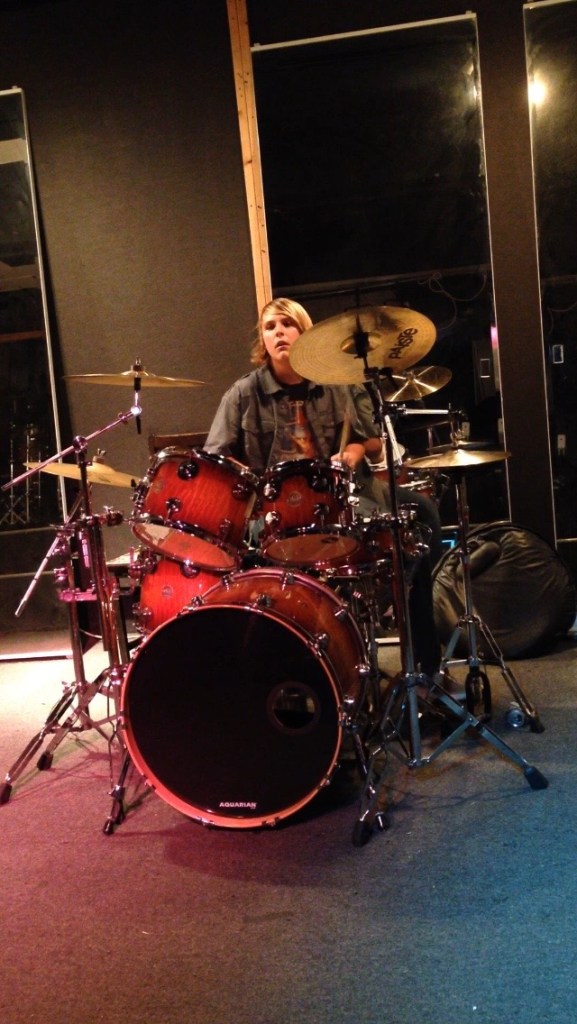
It would be only appropriate to being this with the drum kit I learned to play on. It is my fathers custom DW kit. Its essentially the creme de la creme of drum kits and I, a novice player, was fortunate enough to learn on such fine hardware. I remember having to move and shift all the angles of toms and cymbals to fit my own preferences. I was still coming into my own as a player and a person so the fiery kit acted as a set of training wheels to see if I could go the distance and actually stick with it.
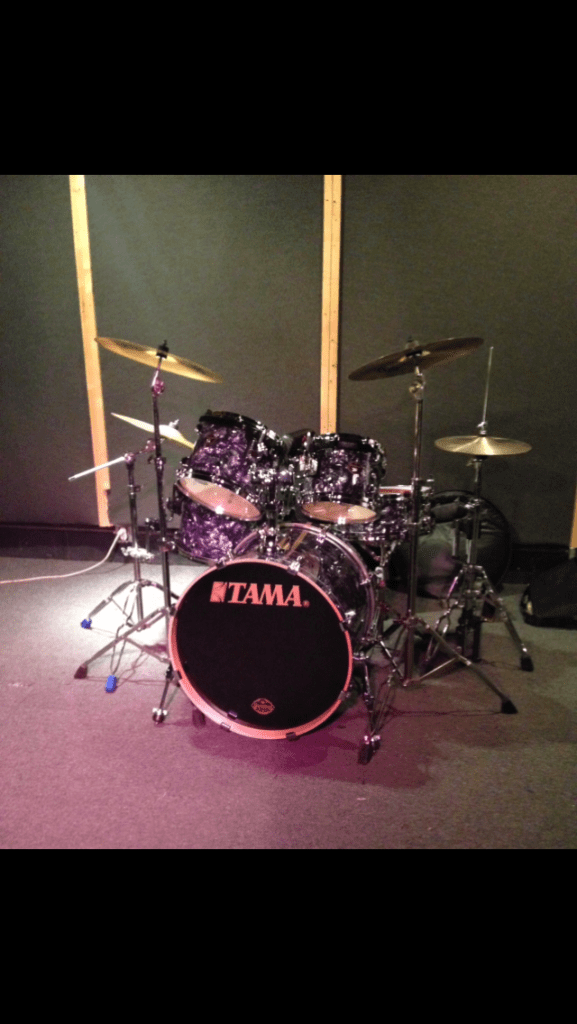
What came next was a kit of my own. It is a Tama, blue oyster, star classic. It was the perfect choice for me. It has white and opalescent pearl inlay as well as a blue finish. Getting the kit was basically the equivalent of having my dad hand me the keys to a muscle car I didn’t think I was worthy of. But having something so beautiful as my own inspired me to become worthy of it. The sight of it takes me back to hours and hours of tireless practice; powering through bloody fingers and trying to give one hundred percent to each song. Seeing it now makes me want to return to it. It almost feels like having a long distance relationship. Luckily shiny, loud lover will never leave me.
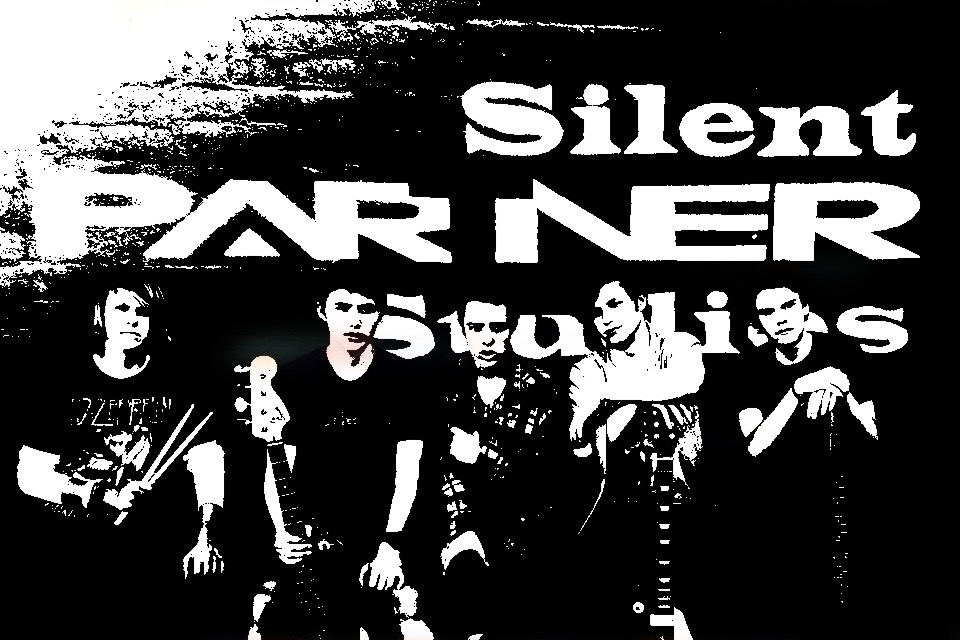
This was a photo taken in from of the studio my first band would rehearse at. I am on the far left trying my hardest to look the part of the drummer. The studio was ironically titled “Silent Partner Studios” though the inhabitants were anything but. We were youngsters amongst seasoned, and cynical older musicians. They spoke to us like we were no different. Age was not a factor in this equation. They would tell us they saw themselves in us, and they would smile wide every time we would arrive. The studio was shrouded in plants, with dirty old couches in every corner. It was a renovated car wash, so each studio space was protected by a three inch thick sliding door that surprisingly didn’t do much for sound proofing. No one minded the bleeding of sound from each room. In between songs it was almost a tradition to sit out on the dusty couches and listen closely as all the differ sounds bounced of the dangling foliage around us. It was a different world and I would take it everywhere with me if I could.
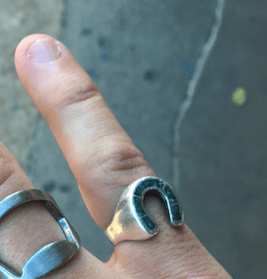
My Aunt Mary’s ring. She was a horse breeder for years and had a house on acres of land with stallions running free. She was my mothers namesake and though we never got to meet I felt a kindred connection to her. I always felt guilty for never having seen her. When she passed away, my mother went to the house to collect relics and antiques and this ring was one of the things she came back with. This was a time of great discovery for myself and I figured I could use the extra good luck. It felt nice to have some sort of talisman to rub if I needed a bit of extra good luck in the day. Not being a religious person, this superstition is about as close to faith as I get. Its nice to carry family with you wherever you go, and feel that they are helping you out in times of need.
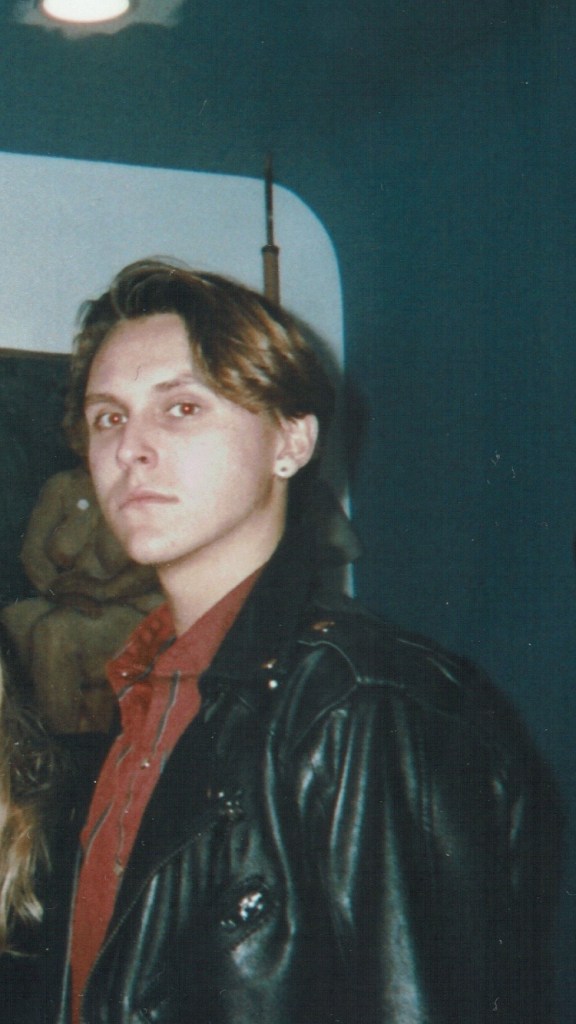
My leather jacket. Modeled after the classic 1950’s motorcycle jacket, mine is constructed of recycled leather. If you look closely at it you can see the cross stitches of different jackets all sown together to make one unified thing. I was attracted to this frankenstein element to the jacket and knew I had to have it. Since that day it goes basically everywhere with me. I always get excited when the winter moths role around and I have an excuse to wear it.
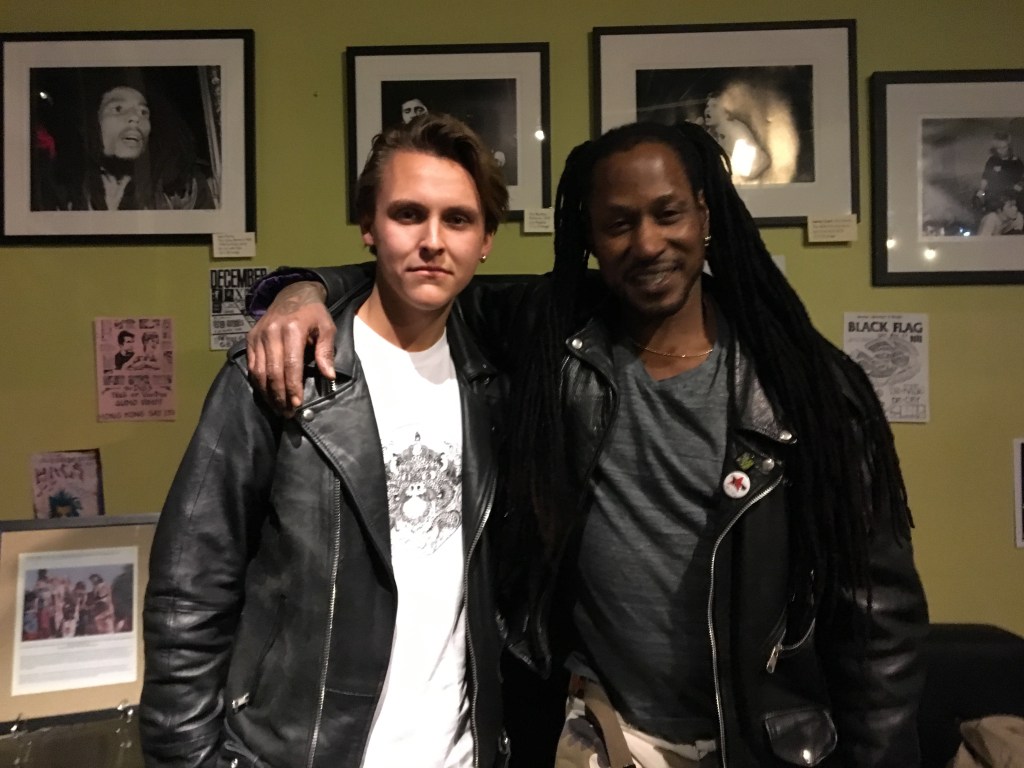
When I met The Dead Kennedy’s drummer, D.H Peligro the first thing I said to him was that we both play the drums and we both have the same taste in jackets. What he said to be will stay with me forever. He looked down at his jacket and said, “Yeah, but this ones got history”. After we shared a light together I really took what he said to heart. Ever since, I have taken that jacket to every gig, concert, show, road trip, or late night adventure. In every stitch I hope to imbue my own personal history and make all the different frankenstein stitched unify to tell my story.
The Weight of Things by Emily Rapp
The story takes us through a mothers grief after the loss of a child. There are no long paragraphs depicting her grief, but rather her fixation on her child’s old, lightly used clothes is our window into her suffering. I liken this piece to a famous, one sentence tragedy; “Baby shoes for sale, lightly used”. The same heaviness that lingers in those words proves this entire piece.
She takes us through her finding out about her sons terminal diagnoses and the rage that accompanied it. The thought that something you love so much will soon be taken from you with no explanation or justice is her struggle. She says that it is unfair, and it is.
Her description of the sympathy cards are my favorite part of this story. She explains her hatred for their dainty, hollow sympathy masked in pastel colors. She says she would prefer the brutal, honest truth over these light and fluffy wishes.
From here she takes us back to her early years. Like Patty Smith (see precious annotation) she begins her story where one ends. Through her coping with death we get insight into her character, but from her past we realize the true weight of her loss.
 Jake Pavlica's Blog